
Reviewed · CHICAGO TOURS
Self-Guided Chicago Loop Tour Explore the City at Your Own Pace
Chicago’s Loop is an open-air lesson in architecture, public art, and city life. This self-guided walk links the river, Millennium Park, and downtown landmarks, with GPS-triggered audio to help you know what you’re looking at without keeping your eyes on a guide.
I like two things in particular: the app gives you freedom to stop and explore, and the route points out details you might otherwise pass without noticing. One consideration: the tour’s two to two-and-a-half-hour estimate leaves little room for a long museum visit, a Skydeck trip, or an unhurried lunch.
At a glance
- Follow a route from DuSable Bridge to Willis Tower, crossing the Loop’s public spaces and riverfront.
- Hear audio at your location using GPS cues, with the tour available offline after you download it.
- See art and architecture together, from Cloud Gate and Calder’s Flamingo to the Rookery Building’s light court.
- Set your own pace and listen again later. One person can make the walk last four or five hours by stopping often.
- Pay $9.99 per person for the app, tour download, and audio guide. Bring your own smartphone.
A city walk that lets you set the tempo
The route covers a lot of ground, but it is not a race from one photo stop to the next. You can pause for a closer look, take a side trip, or replay an audio segment. The tour remains available after you first use it, so you do not have to squeeze every stop into a single outing.
That flexibility matters in Chicago. A public sculpture may need only a few minutes, while a building interior or museum can easily claim more of your day. The route gives you a useful frame for exploring downtown, but your curiosity, and your appetite for indoor stops, will decide how long the walk really takes.
The app is meant to work offline once you have downloaded the tour. GPS-triggered audio plays as you reach locations, and the map helps you follow the route. Download the app and tour before setting off, and make sure your phone is charged. You will need your own smartphone; it is not included.
There is no live guide or set group to keep pace with. This is a private activity for your own group, which makes it a good fit if you prefer to wander, take photos, or give one stop more time than another. The tradeoff is that you will need to manage your own route and attention. In busy streets, check the map when you are safely stopped rather than while crossing.
More self-guided options around Chicago:
- Medieval Torture Museum Ticket with Audio Guide and Ghost Hunting
★ 5.0 · 962 reviews - Eastside Chicago The Heist Exploration Game and Tour
★ 4.0 · 10 reviews - Chicago Self-Guided Audio Tour
★ 4.0 · 9 reviews
From DuSable Bridge to Buckingham Fountain
The starting point at DuSable Bridge puts you right over the Chicago River. The bridge’s double-deck, double-leaf design is part of the city’s working infrastructure, while its ornate towers mark the crossing with scenes from Chicago history. It is an apt opening: this walk is as much about how the city is built as what it puts on display.
From here, the route heads toward Buckingham Fountain, a huge landmark inspired by the fountains at Versailles. Its central jet can shoot 150 feet into the air, with the skyline as a backdrop. The fountain is an outdoor stop with no admission charge, and the suggested visit is brief. If you want to sit and watch the water displays rather than take a quick look, leave yourself extra time.
The opening stretch gives you an immediate contrast between city movement and public space. The bridge links the river’s two sides; the fountain offers a more formal pause among the parks and downtown buildings. The audio can add context, but the fountain’s scale is easy to appreciate without a long explanation.
Art, architecture, and a river crossing
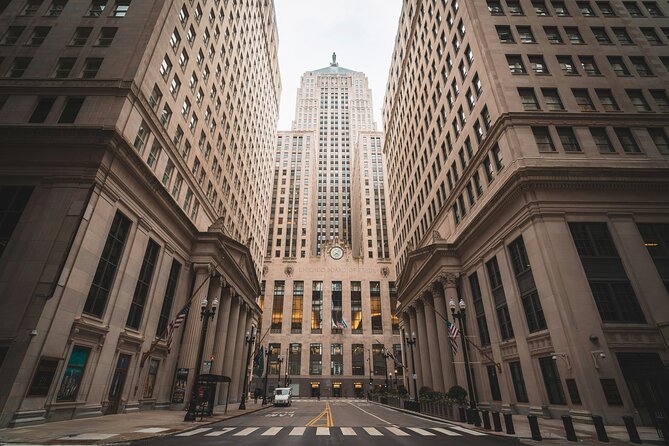
The route brings you to the Chicago Board of Trade Building, a tall Art Deco landmark that once defined the city’s financial district. Look up to spot Ceres, the Roman goddess of agriculture, at the crown. The short stop is enough for an exterior look and a bit of context; do not assume the tour includes access to the lobby.
Next comes the Chicago Cultural Center, a former library that now hosts free cultural programming. Its stained-glass domes are the reason to step inside if the building is open. The tour describes exhibits and performances as part of the center’s role, but schedules can vary, so treat any indoor visit as a bonus rather than a guaranteed event.
DuSable Bridge is also described as a stop along the route, even though it is the starting point. That gives you a second chance to look at its towers and river setting, or to take in details you missed on arrival. The sequence makes sense on foot, but the route is not a museum-style itinerary with a fixed entry time at each location.
Millennium Park’s sculptures and stages
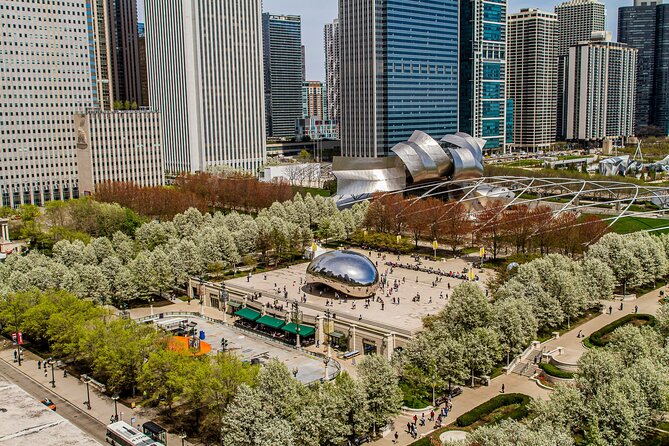
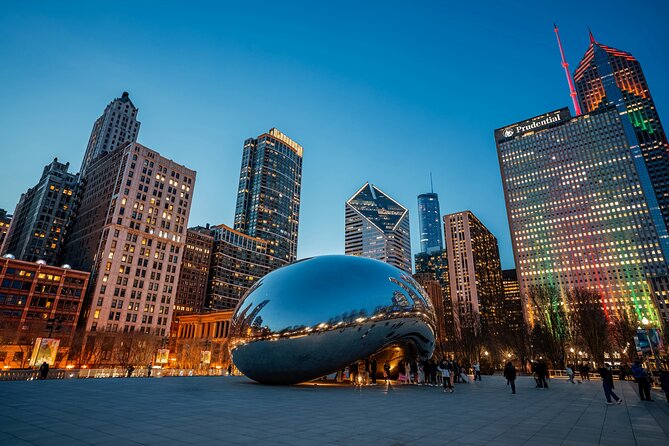
Cloud Gate, known to most people as the Bean, is one of the walk’s signature stops. Its polished surface reflects the skyline and folds you into the scene, which makes it worth circling rather than viewing only from one side. Expect other people to be drawn to the same photo-friendly spot, and allow a little time if you want to look closely.
Crown Fountain turns public art into something playful. Two glass-block towers show video portraits, and water sprays from the structures in summer. The water feature is seasonal, so do not count on a splash if you visit in colder weather. Even when it is dry, the paired towers and human faces make this a different kind of artwork from the polished stillness of Cloud Gate.
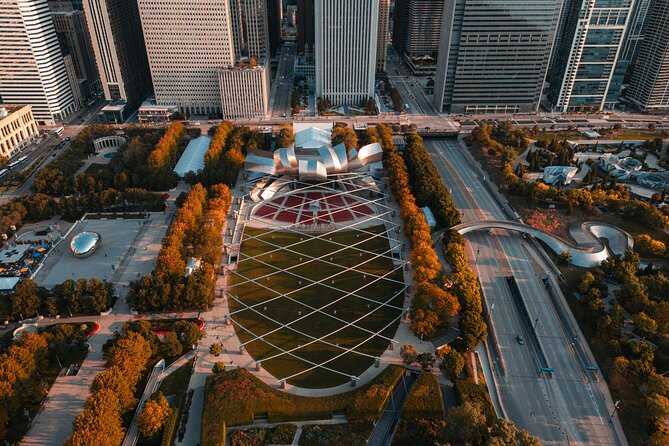
Nearby, Jay Pritzker Pavilion adds a dramatic architectural counterpoint. Frank Gehry designed the outdoor concert venue, whose steel ribbons frame a stage with a state-of-the-art sound system. The pavilion anchors Millennium Park, though a concert is not part of the tour. The value here is in seeing how a performance space can also shape the feel of a public park.
The Millennium Monument offers a calmer note. This semicircular colonnade is a modern recreation of a structure from 1917, honoring Chicago’s founders. It recalls classical forms without pretending to be an ancient ruin. That small distinction makes it an interesting pause amid the park’s more contemporary art.
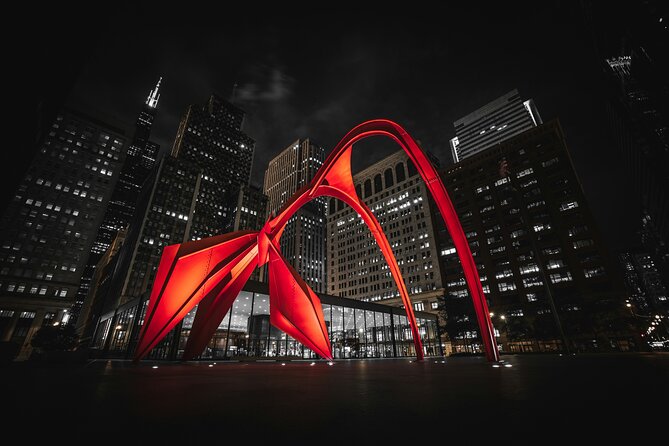
Calder’s Flamingo is harder to miss. Alexander Calder’s large red sculpture stands out against the steel and glass around it, with sweeping curves that invite you to walk around and view it from different angles. The Picasso, another outdoor work, takes a more abstract approach. Pablo Picasso gave the steel sculpture to the city, and its meaning is left open to interpretation. You do not need to identify what it represents to enjoy the way it changes the square around it.
More guided departures around Chicago:
- Chicago River: 1.5-Hour Guided Architecture Cruise
★ 4.8 · 8,046 reviews - Chicago: Gangsters and Ghosts Guided Walking Tour
★ 4.7 · 1,697 reviews - 2-Hour Guided Segway Tour of Chicago
★ 5.0 · 442 reviews - Skip-the-line: Art Institute of Chicago Guided Tour
★ 5.0 · 417 reviews
Inside the Loop’s architectural story
The route’s architecture becomes especially rewarding at the Rookery Building. One of Chicago’s oldest surviving high-rises, it combines Romanesque design with early skyscraper construction. Its light court was redesigned by Frank Lloyd Wright, and the building’s interior mosaics tell stories of early explorers.
The tour description calls attention to the light court, but it does not say that access to the interior is guaranteed. If you are hoping to see inside, check access before you go. Even from the street, the building is a worthwhile stop because it helps explain how Chicago’s early commercial buildings grew upward while still making room for light.
A further architectural stop is described as an 1895 Chicago School high-rise with ornate terra cotta, a bright rotunda, and mosaics about early explorers. It offers a useful contrast with the Rookery: downtown architecture is not only about height, but also the care given to entrances, interiors, and decoration. As with other interior-focused stops, confirm access if seeing inside is important to you.
The route also brings you to the Harold Washington Library Center. Its glass-topped Winter Garden offers a quiet interior retreat from the streets. The building is a public library rather than a paid attraction, but the tour does not specify how much time to spend inside. If you step in, the atrium is a good reason to slow down and look upward.
Miro’s Chicago adds a burst of surrealism to the walk. Joan Miró’s colorful, whimsical sculpture resists a single reading, much like Picasso’s work nearby. Together, the two show how the Loop’s public art ranges from monumental and abstract to playful and personal.
River memories and a high-rise finish
The Vietnam Veterans Memorial Plaza offers a quieter stretch beside the river. Its polished granite walls honor those who served and create a space for reflection amid downtown activity. The short suggested visit is enough to take in the setting, but there is no need to rush past it if you want a moment of quiet.
The McCormick Bridgehouse and Chicago River Museum is another described stop, set inside a working bridgehouse. Exhibits explain the river’s role in Chicago’s growth, and the bridge’s gears show the mechanics behind a lift bridge. The description does not establish whether museum admission is included, so check separately if you plan to go inside.
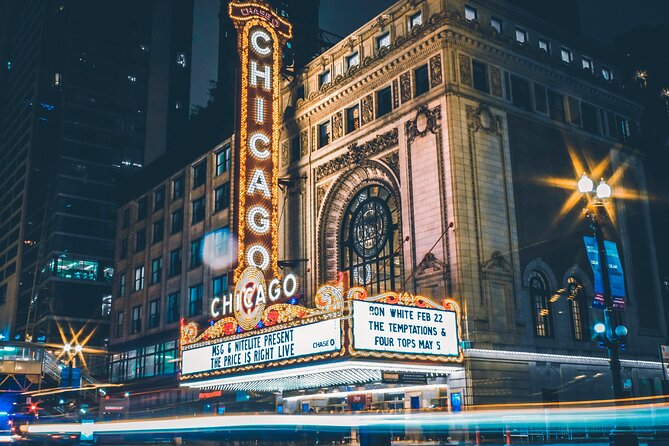
The Chicago Theatre brings the route back to the city’s performance culture. Its marquee is an icon, while the interior is known for French Baroque details. The tour points out the venue’s importance and appearance, but it does not promise a performance or interior visit. If you want to see the ornate rooms, verify access before planning around it.
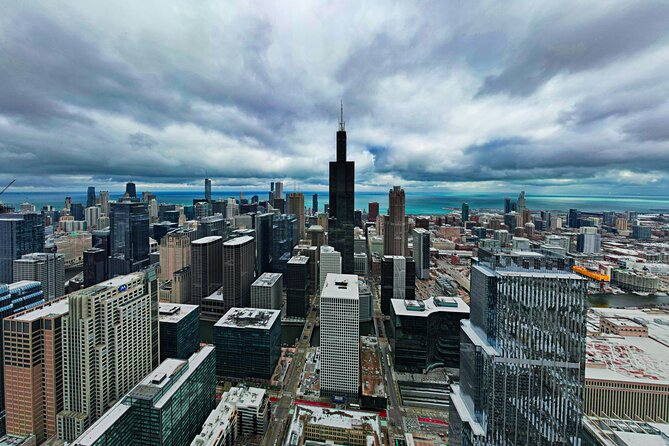
The walk ends at Willis Tower, formerly the world’s tallest building. The Skydeck on the 103rd floor offers wide city views, and The Ledge adds a glass-floor view straight down. These are paid attractions, and the tour price is for the audio walk, not a stated Skydeck ticket. Treat the tower as a possible finale and budget time and admission separately if you want to go up.
What $9.99 buys, and what it does not
At $9.99 per person, the tour is a modest-cost way to connect many downtown sights with a clear route and audio context. You are paying for the app and tour download, flexible access, and an English audio guide. There is no cost for the numbered outdoor stops that are marked free, but the price does not list tickets to paid attractions or guarantee entry to buildings.
The strongest value is the freedom to take your time. The route’s nominal estimate is two to two-and-a-half hours, but you can stretch it considerably. One person found that stopping to take photos and explore turned the walk into a four- or five-hour outing. That is a useful planning clue: think of the estimate as the time for following the route, not a promise that every building, museum, and viewing deck fits inside it.
The audio and GPS map are also practical strengths. Location-based cues help you keep the commentary in step with what is in front of you, and offline access means you do not need cell service once the tour is downloaded. The app requires a code to redeem, so complete that step before you arrive at the starting point rather than sorting it out on the sidewalk.
The main limitation is that a self-guided tour cannot answer questions or adjust its commentary to your interests. You can replay the audio, but you will have to decide for yourself which stops deserve more time. If you want a human guide or guaranteed entry into major attractions, this is not a replacement for a guided visit or a separately booked ticket.
Practical details before you set out
The tour starts at DuSable Bridge, 333 Michigan Avenue, and ends at Willis Tower, 233 South Wacker Drive. The Willis Tower finish is across the river from Chicago Union Station, which may help when planning your next stop. The listed operating hours are 8 a.m. to 8 p.m. daily for the stated period from August 12, 2025, through March 1, 2027.
The experience is offered in English and is described as suitable for most travelers. It is near public transportation, though the route itself is a walking tour. Allow extra time for indoor stops, photos, and rest breaks, and remember that the listed five-minute visits are short suggestions, not a rule.
You can use the tour on any day or at any time, and access does not expire. Free cancellation is available up to 24 hours before the experience; cancellations inside that window are not refundable. Those terms are handy if weather or plans change, but the bigger advantage is that you do not need to commit to a single date for your walk.
Should you book this Loop walk?
Book it if you like exploring independently and want a simple way to connect Chicago’s river, public art, and architecture. At $9.99, the GPS audio, offline map, and replayable commentary offer good value, especially if you plan to pause often and make the route your own.
Skip it if you want a live guide, fixed access to building interiors, or admission to attractions such as the Skydeck included in the price. For an easy introduction to the Loop, though, this walk gives you a solid route and enough context to make the city’s sculptures and buildings more than passing photo stops.
FAQ
How long does the tour take?
The estimated duration is about two to two and a half hours. You can take longer by stopping for photos, exploring buildings, or replaying audio.
Where does the tour start and end?
It starts at DuSable Bridge, 333 Michigan Avenue, and ends at Willis Tower, 233 South Wacker Drive.
Is the tour led by a guide?
No live guide is specified. The tour is self-guided and uses an English-language audio guide in the app.
Do I need cell service during the walk?
No. The tour works offline once you have downloaded it. GPS-triggered audio plays based on your location.
What should I bring?
Bring your own smartphone. The smartphone is not included, and you should download the app and tour before setting out.
Does the tour have a fixed date or time?
No. You can use it any day or time, and access does not expire. The listed operating hours are 8 a.m. to 8 p.m. daily for the stated period.
Are attraction tickets included?
The price includes the app and tour download, flexible access, and audio guide. The numbered outdoor stops are listed as free, but tickets for paid attractions are not listed as included.
Can I cancel for a refund?
Yes, if you cancel at least 24 hours before the experience’s start time. Cancellations made less than 24 hours before the start time are not refundable.
Just added around Chicago
- Travel between Chicago O’Hare and Madison★ 4.5 · 4 reviews
- Walking Tour: Historic Chicago Pubs in River North and the Loop★ 5.0 · 9 reviews
- Verse Immersive Holographic Theater in Chicago★ 4.5 · 28 reviews
- Professional Photo Shoot in Chicago★ 4.5 · 8 reviews
- Private Transfer from Chicago Airport (ORD)★ 3.5 · 3 reviews
- The Devil in the White City: A Haunting History Tour★ 4.5 · 17 reviews
- 2 Hour Chicago Landmarks & Lakefront E-Bike Tour★ 5.0 · 4 reviews
- Chicago Scavenger Hunt Adventure★ 5.0 · 5 reviews
Chicago Tours, compared.
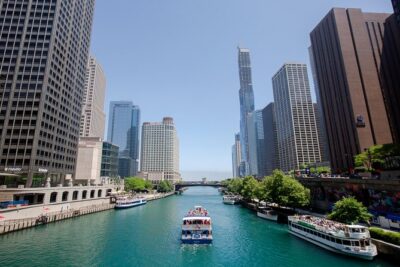
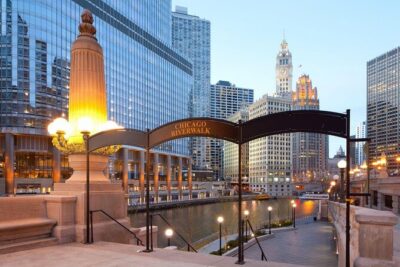
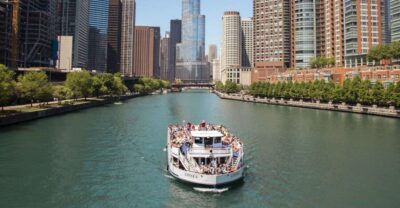
Chicago River: 1.5-Hour Guided Architecture Cruise
Read our review →
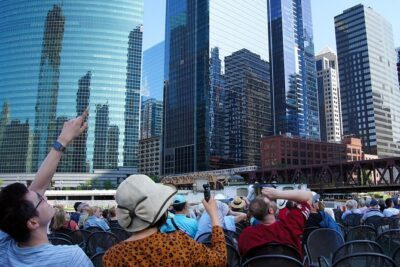
Chicago Architecture Center River Cruise aboard First Lady
Read our review →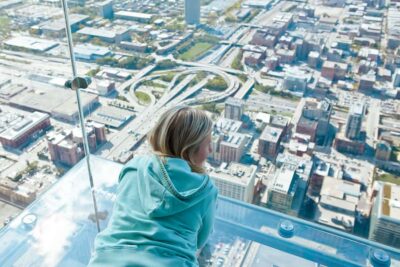
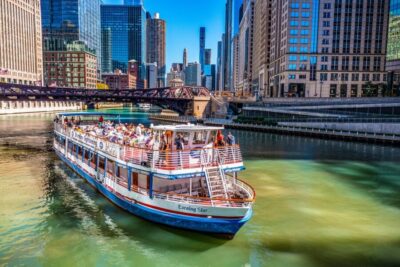
Architecture River Cruise Skip-the-Ticket Line
Read our review →
Browse the lists this tour appears in